
Custom flexible packaging SKLUBS
Custom mylar bags: aluminum barrier, zipper and custom sizing
Mylar is a brand name, not a material. It started out as one manufacturer’s polyester film and became the everyday word for any opaque, high-barrier bag. What you actually buy is a laminate of several layers, and the aluminum does the heavy lifting. Two vendors can both write “mylar” and ship structures whose shelf life differs by a factor of ten. This page lays out what’s inside, and how to read a quote.

From 250
Units per SKU and per size
5 to 7 days
Production, counted from proof approval
Factory-direct
Our office in Guangdong, no middleman
Custom size
Custom dimensions, not a fixed grid
The vocabulary
Custom mylar bags: what the word covers, and what it does not guarantee
When you’re shopping for custom mylar bags, few suppliers explain this, yet it’s the first thing to know before you compare two quotes that use the same word. “Mylar” doesn’t describe any level of performance: it’s a brand name that became everyday language.
| Term | What it originally meant | What it means in practice | What it guarantees |
|---|---|---|---|
| Mylar | A biaxially oriented polyester film, under a registered trademark | Any opaque, high-barrier bag | Nothing, in itself |
| Metallized | An aluminum deposit a few nanometers thick | Often sold as "mylar" | A good barrier, not a total one |
| Aluminum | A foil several micrometers thick | The top of the barrier range | A near-total barrier |
| Laminate | Several films bonded together | The real structure of the product | The only thing the quote should spell out |
| Opaque | Does not let light through | Often confused with "barrier" | Opacity alone does not protect against oxygen |
For a custom mylar bag, insist on the layer-by-layer composition with thicknesses. A supplier who answers "mylar" without detail either does not know what they are selling, or does not want to say.
The typical structure of a custom mylar bag, from the outside in
- Outer layer
- Printable polyester, which carries the print and the finish
- Middle layer
- Aluminum foil or metallization, which provides the barrier
- Inner layer
- Polyethylene, which provides the seal and food contact
- Typical total thickness
- 80 to 160 microns depending on capacity and the barrier targeted
- Options fitted in-line
- Zipper, degassing valve, tear notch, hang hole, child-resistant closure
- Documents supplied
- Food-contact declaration of compliance, structure data sheet
The structure
Metallized or aluminum: the difference nobody mentions, and the reason prices vary so much
This is the central trade-off in a custom mylar bag. The two are sold under the same name, they look the same, and they do not protect in the same way at all.

With an identical barrier structure, the surface finish completely changes how the product is perceived.
A few nanometers versus a few micrometers
On a custom mylar bag, a metallized film carries an aluminum deposit sprayed under vacuum, in the order of a few nanometers. The barrier rises sharply compared with a plain film, for a moderate extra cost. It is the default choice for a product that sells through in a few months.
An aluminum foil is several micrometers thick, a thousand times more. The barrier becomes near-total against oxygen, water vapour and light. The price follows, and recyclability is lost for good.
On a custom mylar bag, the price gap per thousand between the two is real, and it is justified. What is not justified is paying for one while believing you are buying the other: that is exactly what happens when a quote settles for the word “mylar”.
- Metallized film can be folded and creased without losing its barrier
- Aluminum foil can develop microcracks if it is folded too sharply
- Both are fully opaque to light
- Neither can enter a film recycling stream
The barrier
What a custom mylar bag protects, and against what
A custom mylar bag is paid for four distinct protections. Depending on your product, only one really matters, or all four do. That hierarchy should decide the structure, not a range level shown in a catalog.
| Protection | What degrades without it | Who really needs it | Minimum structure |
|---|---|---|---|
| Oxygen | Fats go rancid, aromas fade | Coffee, protein powders, dried fruit, oily products | Metallized at least |
| Moisture | Powders cake, crunch goes soft | Supplements, spices, freeze-dried foods, snacks | Metallized at least |
| Light | Light-sensitive molecules break down | CBD, vitamins, essential oils, natural colorings | Full opacity, so no window |
| Odors, both ways | Aromas escape, neighbouring smells get in | Strongly scented products, mixed packages, shared storage | Aluminum recommended |
On a custom mylar bag, odor is often the real reason for buying, and it is the one least discussed in quotes. A strongly scented product stored with others, or shipped in a mixed parcel, needs a barrier that no plain film can reach.
Get your custom mylar bag priced without waiting on a sales rep.
Send us the format, capacity, structure, finish and quantity, and we’ll return a priced technical proposal. Tell us the target shelf life: it decides between metallized and aluminum, and nothing else does.
- The minimum that applies to your configuration is stated, with the figure
- The layer-by-layer composition appears in the quote, without you having to ask for it
- The flat template of the chosen format is sent to you, with options drawn in
The formats
From 3.5 g to a kilo: what capacity changes on a custom mylar bag
On a custom mylar bag, the barrier structure stays the same across the whole range. What changes is the shape, the stability and the unit cost.
| Capacity | Suitable format | Why | Common options |
|---|---|---|---|
| Around 3.5 g | Flat bag, three seals | Seen in a display case or a box, it does not need to stand up | Zipper, tear notch |
| 7 to 28 g | Flat bag or doypack | Flat costs less, the doypack stands out on the shelf | Zipper, window depending on the product |
| 100 to 500 g | Doypack | Standing up becomes a shelf argument | Zipper, valve for coffee |
| 500 g to 1 kg | Flat bottom, five panels | The base carries the load, two printable side panels | Wide zipper, handle |
| Over 1 kg | Reinforced flat bottom | A flat format becomes unmanageable to handle | Reinforced bottom seal |
The small custom mylar bag format of around 3.5 g is the most requested for products with a high value per gram. It is also the sample format par excellence, and the one where the header strip weighs most in proportion.
A range is built on clear capacities
On a custom mylar bag, the temptation is to multiply intermediate sizes. That is a mistake on two counts: every extra SKU is another setup, and a range whose formats look alike becomes unreadable on the shelf.
Three well-spaced capacities convert better than six that overlap. The difference should be visible from a distance, without reading the label.
Grouping also has a direct effect on price: five SKUs ordered together in the same format share freight and part of the setup, which counts for more than negotiating the price per thousand.

From the small retail unit to bulk, the same barrier structure covers the whole range.
The markets
Who buys custom mylar bags, and why
The mylar bag is strongly associated with CBD, a real B2B market we serve with a dedicated page: custom CBD bags, sizes from 1 g to 28 g, legal text on the back, from 250 pieces. But the same structure serves five other sectors, and each has its own constraint.
CBD and hemp infusions
The most demanding segment, because it combines all four protections: light, odor, moisture and oxygen. Child-resistant closure and tamper-evident seal are frequently requested, depending on the sales channel. Labeling requirements vary by market and change regularly; we print what you approve at proof, and we flag anything we think should be checked before launch.
Specialty coffee
A custom mylar bag does two jobs here: oxygen barrier and carrier for the degassing valve. Freshly roasted coffee gives off CO₂ for several days; without a valve the bag swells, without a barrier the aroma escapes. The two go together. See whole bean coffee packaging.
Sports nutrition and supplements
Hygroscopic powders, fats, light-sensitive vitamins. This is the segment where the barrier is easiest to justify in money terms: a batch that cakes is a batch lost. The anti-powder zipper profile matters here as much as the film structure.
Freeze-dried and long shelf life
Hiking, survival, dehydrated food, meal kits. Here the barrier is not a comfort, it is the product promise itself. Aluminum foil is a given, and the seal is checked with particular rigour.
Solid cosmetics and samples
Soaps, solid shampoos, masks, trial doses. The small format and the opacity protect the actives, and the surface finish carries the positioning. This is the segment where finish matters as much as barrier.
Technical products and collectibles
Moisture-sensitive electronics, trading cards, parts to protect. The custom mylar bag serves first as protection, and only then as branded packaging.

Two finishes, two perceptions
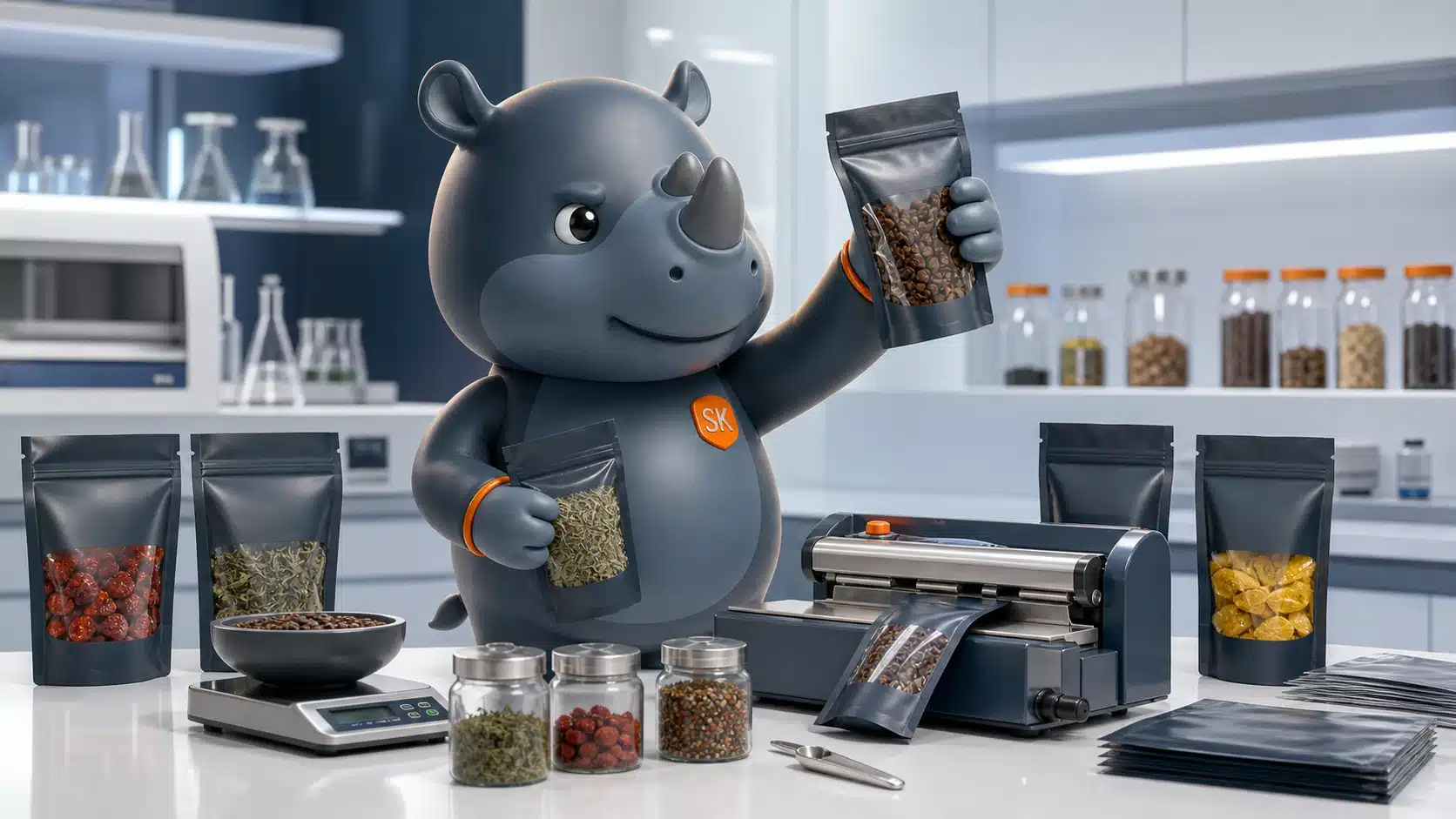
On a custom mylar bag, matte black absorbs light and reads as premium; transparent shows the product but cancels the light barrier.
The flat bottom for larger capacities
On a custom mylar bag of more than five hundred grams, the five-panel base stands better than a simple gusset and offers two printable side panels.
The price
What moves the bill on a custom mylar bag
On a custom mylar bag, the barrier is the dominant cost item, which is not the case on other flexible formats. Here are the levers, from heaviest to lightest.
| Criterion | Digital printing in Europe | Factory-direct, our model |
|---|---|---|
| Minimum order | Very low, often 50 to 100 pieces | 250 pieces per SKU and per size |
| Lead time | A few working days, delivery included | 5 to 7 days of production, plus transport |
| Barrier structures | A limited catalog, rarely detailed | Laminate defined layer by layer, thicknesses included |
| Finishes | Matte or gloss varnish | Soft-touch, hot foil, spot varnish, holographic |
| Options | Simple zipper, sometimes a valve | Four zipper profiles, valve, child-resistant, shaped die-cut |
| Unit price at 250 pieces | The lowest on the market | Higher, logistics are poorly spread |
| Unit price at 1,000 pieces | Comparable | Comparable, the gap closes |
| Unit price at 5,000 pieces and over | Clearly more expensive | Clearly cheaper, the gap widens at every tier |
Order of magnitude taken from public offers on the European market in September 2026. On a custom mylar bag, the tipping point often comes earlier than on other formats, because barrier structures and premium finishes fall outside standard digital catalogs.
The laminate structure
The first cost item, by a wide margin. Moving from metallization to aluminum foil changes the price per thousand far more than any finish. It is also the only trade-off that touches the product promise.
The quantity per SKU
The classic lever. Setup costs are spread across the run, and the unit price of a custom mylar bag drops mainly over the first tiers.
Surface finishes
Soft-touch mattee black, spot varnish, hot foil, holographic effect: each adds a machine pass. On this product the finish often carries the positioning, so it is rarely where to cut.
Functional options
Valve, zipper, tear notch, child-resistant closure, hang hole. Each has a low unit cost and sometimes its own order minimum, which is best known at the brief.
What goes wrong
What usually goes wrong, and what we do to avoid it
These situations are drawn from public reviews by packaging buyers, and a custom mylar bag is as exposed to them as any other printed packaging. None is exotic, all are avoidable, and none is ever written up on the pages of the suppliers it happens to.
What usually goes wrong
The quote says “mylar” and nothing else. The customer compares two offers on price, receives a metallization where they thought they were buying aluminum, and the product goes stale in four months.
What we do
The composition appears layer by layer in the quote, with thicknesses, without you having to ask for it. It is the only way to compare two offers honestly.
What usually goes wrong
The color is not the same from one order to the next. On a matte black, the slightest gap is seen immediately.
What we do
The approved sample is kept as a physical reference and every reorder is checked against it, not against a screen. On deep blacks, we reserve the same reel wherever possible for a given SKU.
What usually goes wrong
The foil bleeds, the spot varnish has no relief. The effects are sold on the quote but not checked separately.
What we do
Each effect is a separately controlled machine pass, and the sample covers the final finish, not a close equivalent.
What usually goes wrong
The valve has been fitted, but the bag swells anyway. The valve flow rate does not match the product’s degassing.
What we do
We ask for the time between roasting and packing at the brief. It determines the valve flow rate, and it is a question almost nobody asks.
What usually goes wrong
The order is forgotten in production. The customer finds out about the delay by chasing it themselves.
What we do
The five to seven days start from written approval of the proof, and our office in Guangdong sends a progress update with photos before shipping, without you having to ask.
What usually goes wrong
The bag is advertised as recyclable because it is flexible and thin. It is not, and the claim exposes the brand.
What we do
A laminate containing aluminum enters no film recycling stream, and we say so before printing. If recyclability matters more than shelf life, look at mono-material, with a shorter product life.
The process
From the first question to the delivered carton, step by step
A custom mylar bag is ordered in six steps, three of which depend on you. The five to seven day lead time only starts at the fourth.
1
The product brief
What your custom mylar bag must hold, at what capacity, in what quantity, and above all for what shelf life. That last answer alone decides between metallized and aluminum.
2
The technical proposal
A structure written layer by layer with thicknesses, a format, options and a price per tier. You can compare it with another offer, line by line.
3
The sample
A blank custom mylar bag in the chosen format and structure. On a matte black film, the real result cannot be judged on any screen: you need the material in your hand.
4
The proof
Your file laid onto the real template, checked, legal text included, then approved in writing. The production lead time starts from there.
5
Production and inspection
Five to seven days. Our office checks the seals, color rendering, the performance of the options and the packing, and sends photos and videos.
6
Shipping
The shipping mode and transit time are quoted by destination before payment, along with what remains payable on arrival. You always speak to the same person.
Frequently asked questions
What people ask before ordering a custom mylar bag
Is mylar plastic or aluminum?
Both, in stacked layers. A custom mylar bag is a laminate: a polyester film on the outside that carries the print, an aluminum layer in the middle that provides the barrier, and a polyethylene on the inside that provides the seal and food contact. The word “mylar” originally referred to the polyester film alone, under a registered trademark; usage has stretched it to the whole structure.
What is the difference between metallized and aluminum?
Thickness, by a factor of about a thousand. A metallized film carries an aluminum deposit a few nanometers thick: the barrier rises sharply for a moderate extra cost. An aluminum foil is several micrometers thick: the barrier becomes near-total, and the price follows. Both are sold under the name custom mylar bag, which explains a good part of the gaps between quotes.
What is the minimum quantity for a custom mylar bag?
Two hundred and fifty units per SKU and per size on standard structures. Some options raise that floor, notably the child-resistant closure or a shaped die-cut. The minimum that applies to your configuration is stated with the figure, and the quote confirms it within forty-eight working hours.
Is it suitable for food contact?
Yes, the inner layer determines this, and it is designed for it. A food-contact declaration of compliance accompanies the order and also covers the zipper and the valve, which touch the product. Food-contact requirements vary by market, so please confirm those that apply to yours.
Is a custom mylar bag recyclable?
No, and it is better to say so plainly. A laminate of several materials containing aluminum cannot be separated and enters no film recycling stream. That is the price of the barrier. If recyclability matters more than shelf life, look at mono-material, with a shorter product life. In every case, packaging placed on a market may also fall under local rules on extended producer responsibility , which vary by country and which you should confirm for your own market.
Can I have a transparent window?
Yes, a custom mylar bag accepts a window, as long as you know the trade-off. The window cancels the barrier over its surface and lets light through. On a light-sensitive product, it measurably shortens shelf life. Many brands end up choosing a small porthole rather than a large window, or drop it after seeing the sample.
Is the 3.5 g format a standard?
It is the most requested custom mylar bag format for products with a high value per gram, and it is indeed very common. The exact dimensions vary with the density of the product: we start from your actual product, not from a grid. It is also the best sample format, because it can be posted at no extra cost.
Can a degassing valve and a zipper be fitted together?
Yes, on a custom mylar bag the two sit together on the same line. The valve lets CO₂ out without letting oxygen in, and the zipper keeps the contents fresh after the first opening. On freshly roasted coffee, both are expected. The valve flow rate is chosen according to the time between roasting and packing.
How long between order and delivery?
Five to seven days of production, counted from written approval of the proof, plus transport. The quote goes out within forty-eight working hours. The most variable phase is the artwork, and it depends on you: that is why the lead time starts from the proof and not from the order.
What if I do not have a file ready?
We supply the flat template of the chosen format, with the seal zones, the position of the options and the bleed already drawn. Our guide to preparing your files details the accepted formats and resolution. If the design has yet to be created, our design services catalog takes it on, with prices shown.
Tell us what you're packing, and how long it has to last.
The product, how sensitive it is and the quantity per SKU are enough for a first priced technical proposal. We’ll tell you straight whether a metallization is enough, or whether your product needs true aluminum foil.